Wholesale Metal Zipper Cutting And Finishing Machine Supplier
Metal zipper production lines require precise cutting, edge finishing, and tooth forming in a single continuous operation. This page describes the core machine architecture, typical performance
Wholesale Metal Zipper Cutting and Finishing Machine Supplier
Metal zipper production lines require precise cutting, edge finishing, and tooth forming in a single continuous operation. This page describes the core machine architecture, typical performance envelopes, and the customization pathways that industrial buyers evaluate when sourcing at volume.
Technical Specifications
| Parameter | Typical Value | Customization Range |
|---|---|---|
| Cutting width (mm) | 30‑120 | Customizable according to project requirements |
| Maximum line speed (m/min) | 45 | 30‑60 depending on motor selection |
| Tooth pitch options (mm) | 1.5, 2.0, 2.5, 3.0 | Additional pitches on request |
| Drive type | Servo‑direct drive | Stepper or hybrid available |
| Control system | PLC + HMI (7‑inch) | Industrial PC or remote I/O optional |
| Power supply | 380 V / 50 Hz 3‑phase | 415 V / 60 Hz on request |
| Machine footprint (L×W×H, mm) | 2800 × 1200 × 1650 | Modular frames for space‑constrained plants |
| Weight (kg) | ≈ 2100 | Varies with added modules |
Key Engineering Features
- Servo‑direct drive eliminates backlash, delivering repeatable tooth geometry within ±0.02 mm across the full cutting width.
- Integrated pneumatic tension control maintains constant zipper tape feed, reducing edge curl at speeds above 40 m/min.
- Modular die‑set carrier allows tool change in under three minutes, supporting rapid SKU switches for mixed‑order runs.
- Closed‑loop temperature monitoring on the finishing rollers prevents overheating of coated metal tapes, extending roller life by an estimated 30 %.
- EtherNet/IP and PROFINET interfaces enable line‑level data acquisition for OEE tracking without additional gateways.
Industry Applications
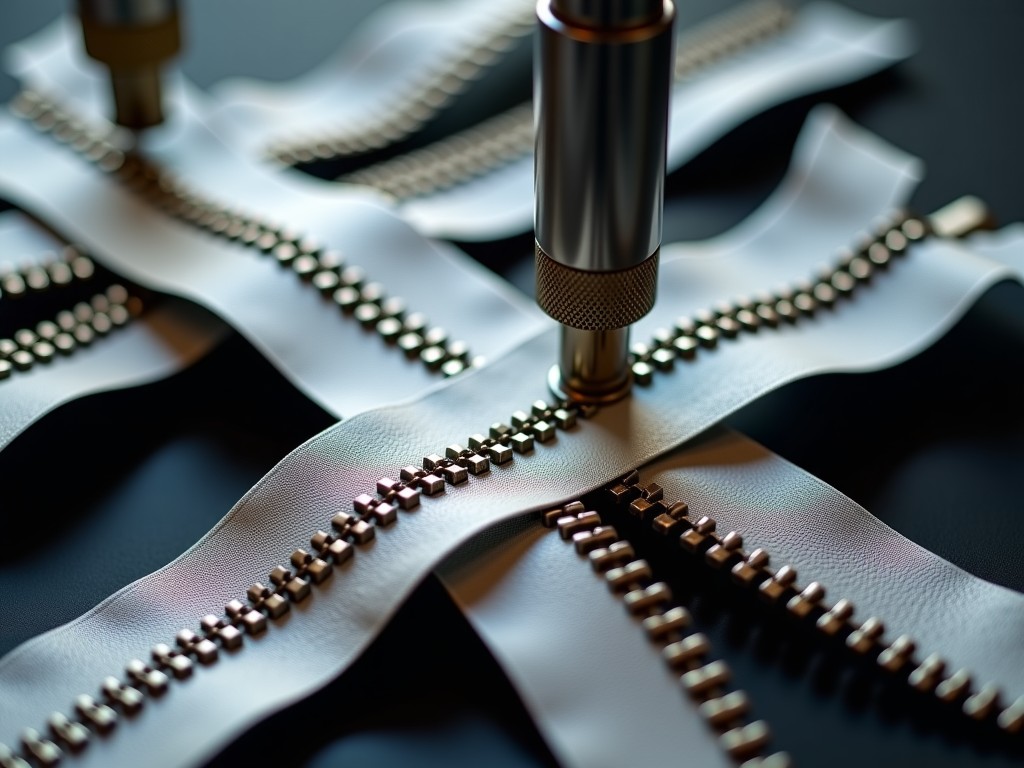
Apparel manufacturers producing heavy‑duty outerwear benefit from the machine’s ability to process 0.8‑1.2 mm thick brass or aluminum tape without deformation, a requirement that standard plastic‑zipper lines cannot meet.
Automotive interior suppliers use the same platform for seat‑track zippers where tensile strength and corrosion resistance are validated against ISO 9227 salt‑spray cycles; the finishing rollers apply a uniform micro‑lubricant film that survives 500 h exposure.
Luggage and tactical gear producers value the quick‑change die system because seasonal collections demand frequent tooth‑profile changes (e.g., 2.0 mm to 3.0 mm pitch) while maintaining a single production cell footprint.
Customization Options
- Cutting width extensions up to 200 mm for wide‑tape industrial zippers.
- Alternative roller coatings (TiN, DLC) for abrasive tape alloys.
- Integrated vision inspection station with 5 µm resolution for real‑time tooth profile verification.
- Dual‑lane configuration delivering two independent zipper streams from a single frame.
- Custom HMI language packs and user‑defined recipe storage up to 200 profiles.
Quality Assurance and Inspection
Each unit undergoes a three‑stage acceptance test: (1) geometric verification of tooth pitch and height using a calibrated optical comparator, (2) dynamic run‑in at 90 % rated speed for 2 hours while logging servo current and vibration spectra, (3) final dimensional audit of a 10 m sample zipper against the buyer’s specification sheet. Inspection records are stored in the machine’s PLC and can be exported via USB or network for traceability.
Packaging, Shipping, and Export Protection
Machines are secured on fumigated wooden pallets, wrapped in VCI‑impregnated stretch film, and fitted with shock‑absorbing corner brackets rated for 5 g vertical impact. Sea‑freight containers receive desiccant packs calculated at 1 kg per cubic meter to maintain < 30 % RH during transit. Documentation includes a packing list, certificate of conformity, and a pre‑filled customs declaration for HS 8445.10.
Frequently Asked Questions
Can the cutting width be tailored to a specific tape size?
Yes. The frame is designed with adjustable guide rails; widths from 30 mm up to 200 mm are achievable by swapping the guide set and recalibrating the servo offsets.
What information is needed before a formal quotation?
Typical tape material, thickness, desired tooth pitch, target line speed, and any required auxiliary modules (vision, dual‑lane, special coating). A short process flowchart helps us size the drive and control architecture accurately.
Which metal tape alloys are compatible?
Brass, aluminum, stainless steel (304/316), and nickel‑silver alloys up to 1.5 mm thickness have been validated. Harder alloys may require upgraded roller coatings, which are offered as an option.
How is quality inspected before shipment?
Refer to the Quality Assurance section above; a full test report with measured tooth geometry, vibration RMS, and temperature logs accompanies each machine.
What are the standard packaging options for export?
Standard export crating includes VCI film, desiccant, and shock brackets. Custom crating (e.g., ISPM‑15 compliant heat‑treated pallets) is available on request.
What is the typical production lead time?
For a standard configuration, 6‑8 weeks from order confirmation to ex‑works. Custom modules add 2‑4 weeks depending on engineering complexity.
How are samples arranged?
A 5‑meter sample zipper can be produced on the buyer’s tape material after a brief tooling setup; shipping costs are billed at cost.
Request a Quotation
Provide your tape specifications and desired output rate; our application engineers will return a detailed proposal within two business days.
Contact technical sales for a formal quote