Wholesale Automatic Zipper Making Machine Supplier
Supplying fully automatic zipper production lines for nylon, metal, and plastic coil profiles. Equipment covers tape feeding, chain forming, slider mounting, and cutting-to-length with PLC-controlled
Wholesale Automatic Zipper Making Machine Supplier
Supplying fully automatic zipper production lines for nylon, metal, and plastic coil profiles. Equipment covers tape feeding, chain forming, slider mounting, and cutting-to-length with PLC-controlled synchronization. Customizable output speeds from 80 to 220 meters per minute depending on zipper type and tooth pitch.
Machine Architecture and Process Flow
An automatic zipper making machine integrates multiple forming stations into a single continuous line. The process begins with tape unwinding and tension control, where dual servo-driven rollers maintain consistent feed rate within ±0.1 mm. This precision prevents tooth misalignment during high-speed chain forming.
For nylon coil zippers, the injection molding station uses a multi-cavity mold heated by cartridge heaters with PID temperature control ±1°C. Molten polyamide 66 is injected at 280–300°C, forming teeth directly onto the tape. Cycle time per tooth pitch averages 0.18 seconds at 150 m/min line speed.
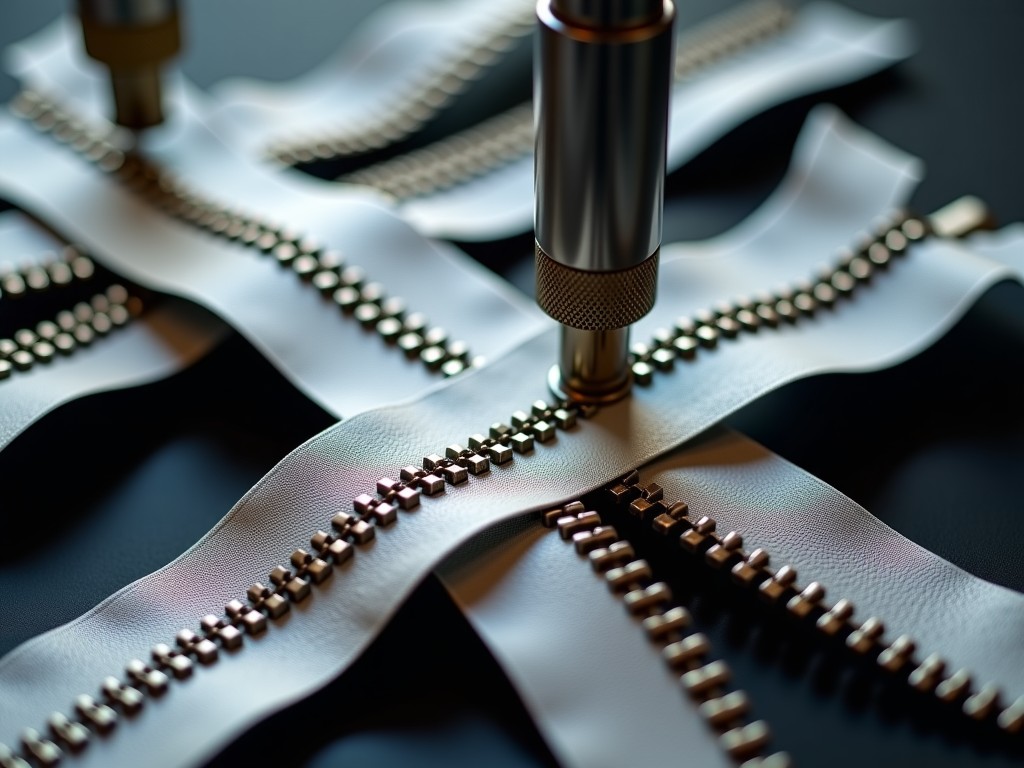
Metal zipper lines replace injection with a progressive die stamping system. Brass or aluminum wire feeds through a straightening unit, then enters a high-speed press rated at 25–40 tons. The die cuts, forms, and clinches teeth onto the tape in one stroke. Press speed is adjustable up to 400 SPM (strokes per minute).
Plastic injected tooth lines (Delrin/POM) follow a similar injection principle but require higher clamping force — typically 80–120 tons — due to material viscosity. A robotic pick-and-place unit transfers molded tooth chains to the tape bonding station, where ultrasonic welding or hot-air sealing achieves peel strength ≥ 18 N/cm.
Downstream, slider mounting heads automatically orient and press sliders onto the chain. Vision inspection cameras verify tooth engagement, slider position, and tape edge alignment at full production speed. Defective sections are marked and diverted to a rework conveyor without stopping the line.
Technical Specifications Comparison
The table below summarizes typical parameters across three common zipper categories. Values represent standard configurations; final specifications are customized per project requirements.
| Parameter | Nylon Coil (Auto Injection) | Metal (Stamping) | Plastic Injected (POM) |
|---|---|---|---|
| Standard Tooth Size | #3, #4, #5, #8, #10 | #3, #5, #7, #8, #10 | #3, #5, #8, #10 |
| Max Line Speed | 220 m/min | 180 m/min (400 SPM) | 120 m/min |
| Tape Width Range | 10–32 mm | 10–32 mm | 10–32 mm |
| Main Drive Motor | Servo 7.5–15 kW | Servo 11–22 kW + Press | Servo 15–30 kW |
| Heating/Injection Zones | 6–12 zones PID controlled | N/A (mechanical forming) | 8–16 zones PID controlled |
| Compressed Air Requirement | 0.6 MPa, 1.2 m³/min | 0.6 MPa, 1.5 m³/min | 0.6 MPa, 1.8 m³/min |
| Footprint (L × W × H) | ≈ 12 × 2.5 × 2.2 m | ≈ 14 × 3 × 2.5 m | ≈ 16 × 3.5 × 2.5 m |
| Control System | Siemens S7-1500 / Beckhoff CX | Siemens S7-1500 / Beckhoff CX | Siemens S7-1500 / Beckhoff CX |
| Changeover Time (Size) | 45–60 min (mold swap) | 60–90 min (die change) | 60–90 min (mold swap) |
Note: All lines support Industry 4.0 data interfaces (OPC UA, MQTT) for MES integration. Remote diagnostics module included as standard.
Material Compatibility and Tape Considerations
Tape material directly affects forming quality and line stability. Polyester (PET) tape dominates general apparel due to dimensional stability — shrinkage < 0.5% after 150°C heat setting. Cotton tape requires pre-heating stations to manage moisture absorption; otherwise, tooth adhesion drops 15–20%.
For waterproof zippers (PU-coated or TPU-laminated tape), the coating layer must withstand forming temperature without delamination. Our lines include infrared pre-heat zones (adjustable 80–140°C) to activate adhesive before tooth engagement. This prevents cold-bond defects common in outdoor gear production.
Reflective tape, used in safety garments, introduces surface hardness variations. The tape tension controller compensates via closed-loop load cell feedback (0–50 N range, 1 kHz sampling). Without this, reflective coating cracking occurs at speeds above 100 m/min.
Monofilament edge tape (for invisible zippers) requires specialized edge-guide sensors. Standard optical sensors misread transparent edges; we integrate ultrasonic edge detectors with 0.05 mm resolution. This option adds one servo axis per tape reel but eliminates edge-wave defects entirely.
Quality Assurance and Inspection Integration
Every machine ships with inline inspection as standard, not optional. The vision system uses two 5 MP global-shutter cameras: one top-down for tooth profile, one side-view for slider engagement. Inspection criteria include tooth height (±0.05 mm), pitch consistency (±0.03 mm), tape edge straightness (±0.1 mm/m), and slider lock engagement force (3–8 N range).
Data logging captures every zipper meter produced. Each roll receives a unique QR code linking to its production batch, operator ID, material lot, and real-time parameter trends. This traceability meets automotive (IATF 16949) and medical device (ISO 13485) supplier requirements without additional software investment.
Statistical process control (SPC) charts run on the HMI. Cp/Cpk values for critical dimensions update every 500 meters. When Cpk drops below 1.33, the system flags the roll for 100% re-inspection and alerts maintenance. This prevents drift from tool wear — injection mold cavities typically last 2–3 million teeth before re-polish.
Offline, we provide a calibration kit: digital micrometer (0.001 mm resolution), tensile tester for crosswise strength (0–500 N), and peel fixture for tape-tooth adhesion. Annual calibration service available through regional partners.
Customization Scope for OEM and Volume Buyers
Wholesale orders typically involve configuration rather than redesign. The modular frame allows adding or removing stations: double-chain output (two parallel zipper chains from one line), automatic boxing, or RFID tag insertion at the cutting station.
For brands requiring proprietary tooth profiles, mold design service is included. Lead time for custom mold: 4–6 weeks after 3D approval. We simulate filling analysis (Moldflow) for nylon/POM to predict weld lines and shrinkage before steel cutting. Metal die design includes finite element analysis of stamping force distribution to prevent premature cracking.
Control system language packs: English, Chinese, Vietnamese, Turkish, Spanish, Portuguese, Arabic. HMI screen size 15.6" or 21.5" capacitive multi-touch. Safety compliance: CE (Machinery Directive 2006/42/EC), UL 1740 for North American markets, KC for Korea. Documentation package includes electrical schematics (EPLAN), pneumatic diagrams, and risk assessment report.
Packaging for export: main frame on steel skid with vibration-damping mounts, control cabinet in wooden crate with desiccant and VCI film. Container loading optimized — one 40'HQ holds one complete nylon line or one metal line with spare parts kit. Shipping marks and customs HS code (8448.59) provided in advance.
Frequently Asked Questions
Can the machine produce both open-end and closed-end zippers?
Yes. The cutting station includes a programmable stop-position module. For open-end, the chain cuts before slider mounting; for closed-end, after. Changeover takes < 2 minutes via HMI recipe selection.
What information is required for a formal quotation?
Zipper type (nylon/metal/plastic), tooth size(s), tape material and width, target daily output (meters or pieces), single/double chain, slider type (auto-lock, non-lock, pin-lock), and destination country for certification.
How is installation and training handled?
Two options: (1) Factory acceptance test (FAT) at our facility — your engineers spend 5 days for hands-on training before shipment. (2) On-site commissioning — we dispatch 1 mechanical + 1 electrical engineer for 7–10 days. Travel, accommodation, and visa costs billed at actual.
What is the typical production lead time?
Standard configuration: 60–75 calendar days after deposit and drawing approval. Custom molds/dies add 4–6 weeks. Peak season (Q3/Q4) may extend by 15–20 days. Progress updates with photos provided biweekly.
Are spare parts available long-term?
Yes. We maintain 10-year spare parts commitment for all serialized machines. Critical wear parts (mold inserts, stamping dies, heater bands, servo motors) stocked regionally in Germany, Turkey, Vietnam, and Mexico. Consumables kit (filters, seals, belts) included with each machine.
Request Technical Proposal
Share your zipper specifications and volume targets. We return a detailed layout drawing, cycle time analysis, and investment breakdown within 3 business days.
Submit Inquiry for Quotation