Factory Direct Zipper Tape Cutting Machine Suppliers
Direct‑source manufacturers supply zipper tape cutting equipment that integrates a servo‑driven feed, a hardened carbide blade, and a PLC‑based length controller. The machine cuts polyester, nylon,
Factory Direct Zipper Tape Cutting Machine Suppliers
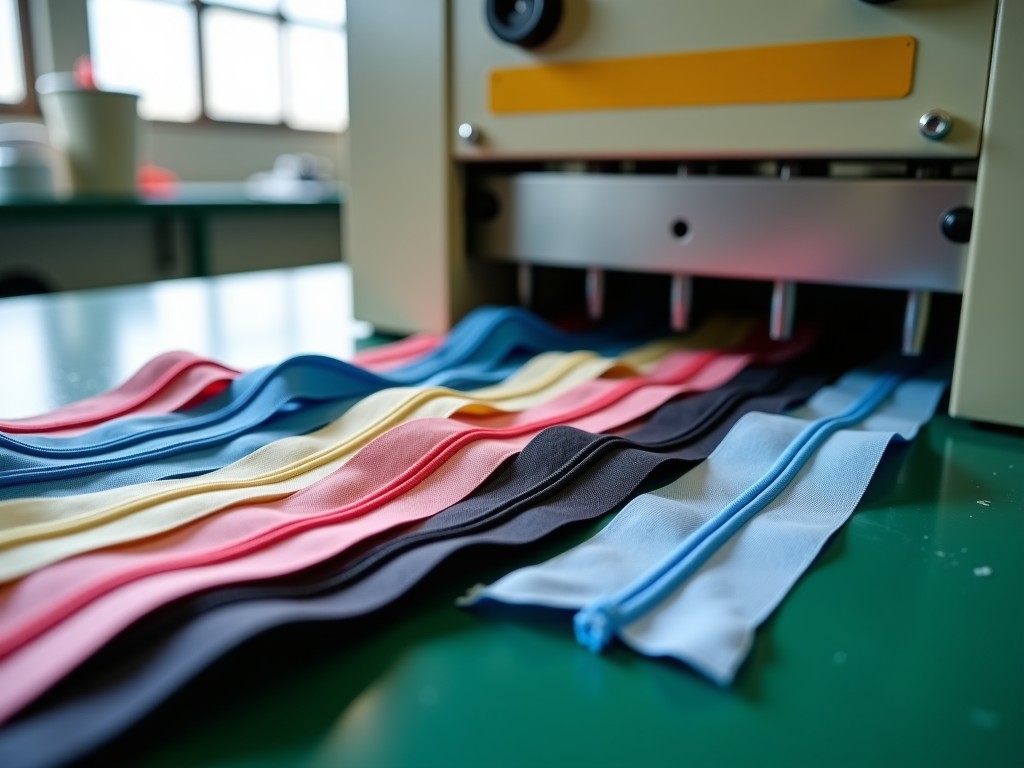
Direct‑source manufacturers supply zipper tape cutting equipment that integrates a servo‑driven feed, a hardened carbide blade, and a PLC‑based length controller. The machine cuts polyester, nylon, or cotton tape at widths from 3 mm to 30 mm with a repeatability of ±0.05 mm.
Because the feed rollers are driven by a closed‑loop encoder, speed variations caused by tape tension changes are compensated in real time, reducing edge burrs and minimizing waste. The control panel stores up to 99 cutting programs, each defined by length, quantity, and pause time.
Technical Specifications
| Parameter | Typical Value | Notes |
|---|---|---|
| Cutting width range | 3 mm – 30 mm | Adjustable via interchangeable guide plates |
| Maximum cutting speed | 120 m/min | Depends on tape material and thickness |
| Motor power | 1.5 kW servo | Closed‑loop encoder feedback |
| Blade material | Tungsten carbide, TiAlN coated | Replaceable without tooling |
| Control system | PLC with 7‑inch HMI | Stores 99 programs, USB data export |
| Overall dimensions (L×W×H) | 1,200 mm × 650 mm × 1,400 mm | Customizable for layout constraints |
| Machine weight | ≈ 420 kg | Includes base frame and safety enclosure |
Application Scenarios
Apparel manufacturers use the cutter to produce zipper tapes for jackets, sportswear, and luggage where consistent length reduces sewing line stoppages. The ±0.05 mm repeatability eliminates the need for manual trimming after stitching.
Automotive interior suppliers benefit from the machine’s ability to handle high‑temperature resistant tapes (e.g., aramid blends) without blade wear acceleration, thanks to the TiAlN coating that maintains edge hardness up to 300 °C.
Packaging converters integrate the cutter inline with reel‑to‑reel slitters, feeding cut lengths directly into heat‑seal stations. The programmable pause function synchronizes with downstream equipment cycle times.
Customization Options
- Guide plate sets for non‑standard tape widths (down to 1 mm)
- Dual‑blade configuration for simultaneous two‑track cutting
- Integrated vision inspection for edge quality verification
- Alternative drive: pneumatic feed for low‑volume job shops
- Extended safety light curtain height for operator ergonomics
Quality Assurance & Inspection
Each unit undergoes a 48‑hour run‑in at rated speed while logging blade temperature, vibration spectra, and cut length deviation. Acceptance criteria require mean deviation ≤ 0.04 mm and zero blade chipping events. A final dimensional audit checks frame squareness within 0.2 mm per meter.
Packaging & Shipping
Machines are secured on a fumigated wooden pallet, wrapped in VCI film, and braced with steel strapping to prevent movement during sea freight. Standard export crate dimensions are 1,300 mm × 750 mm × 1,500 mm; custom crating is available for oversized configurations.
Frequently Asked Questions
Can the cutting width be customized beyond the standard range?
Yes. Guide plates are machined to order; widths down to 1 mm and up to 50 mm have been produced for special projects.
What information is required before a quotation?
Tape material, thickness, required width range, target production speed, and any integration constraints (e.g., existing line height).
Which blade materials are available?
Standard tungsten carbide with TiAlN coating; optional PCD (polycrystalline diamond) for abrasive tapes.
How is quality inspected before shipment?
Run‑in test, dimensional audit, vibration analysis, and a documented inspection report are provided with each machine.
What packaging methods are offered for export?
Standard VCI‑wrapped pallet, optional seaworthy wooden crate, and custom shock‑absorbing foam inserts for sensitive electronics.
What is the typical production lead time?
4–6 weeks for standard configurations; 8–10 weeks when custom guide plates or dual‑blade kits are required.
How are samples arranged?
A short test run (up to 200 m of tape) can be performed at the factory; video and cut‑sample logs are shipped with the report.