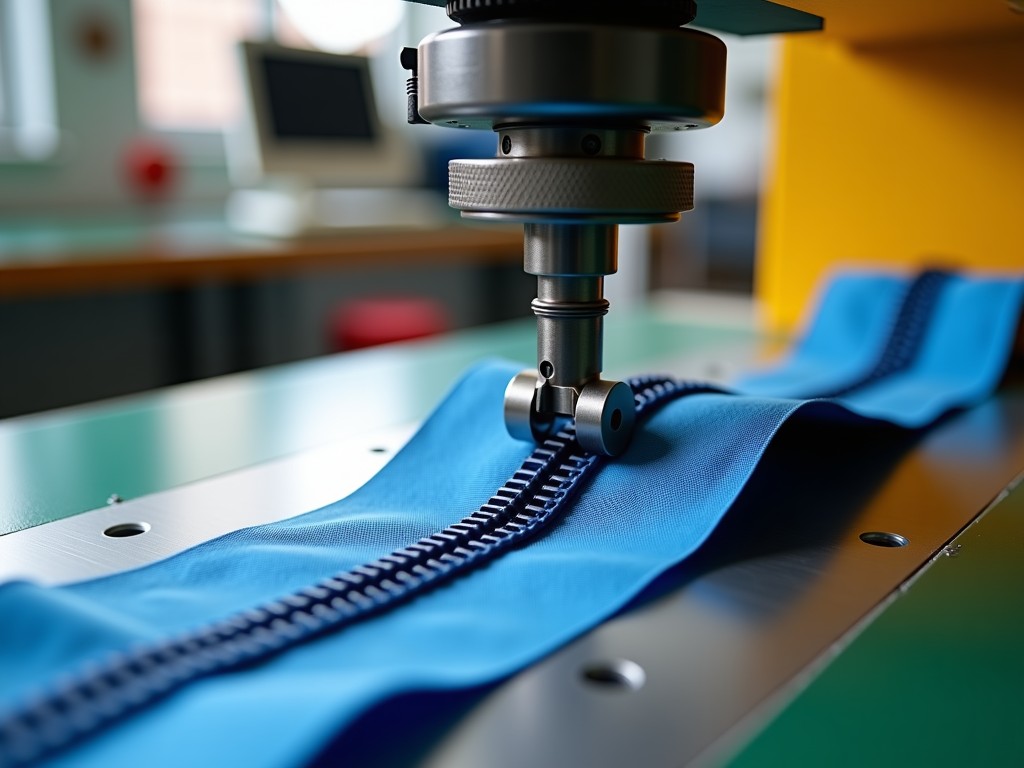
Custom Zipper Length Setting And Cutting Machine Company
Precision length control ±0.5 mm. Servo-driven feed. Handles coil, chain, and molded zipper types. Changeover in under three minutes. Zipper length setting and cutting machines sit between continuous
Custom Zipper Length Setting and Cutting Machine
Precision length control ±0.5 mm. Servo-driven feed. Handles coil, chain, and molded zipper types. Changeover in under three minutes.
Technical Overview
Zipper length setting and cutting machines sit between continuous zipper chain production and final garment assembly. The core challenge is maintaining dimensional accuracy across variable pitch profiles — coil zippers compress differently than molded tooth chains under tension. Our platform addresses this through closed-loop servo feed with real-time encoder feedback, eliminating the cumulative error inherent in stepper-based open-loop systems.
The machine integrates three functional zones: a tension-controlled unwind station, a programmable length-setting module with dual-grip feed rollers, and a cutting station selectable between cold shear, hot knife, or ultrasonic seal depending on tape material. Each zone operates independently under a single PLC, allowing recipe-based changeover without mechanical adjustment.
Cycle time for a standard 150 mm coil zipper length: 1.2 seconds. For 600 mm molded chain with ultrasonic end seal: 2.8 seconds. Throughput scales linearly with length — the feed rate caps at 120 m/min, the practical limit for tape integrity.
Key Specifications
| Parameter | Standard Range | Notes |
|---|---|---|
| Length setting range | 20 mm – 2,500 mm | Extended to 5,000 mm on request |
| Length accuracy | ±0.5 mm (coil), ±0.8 mm (molded) | Measured at 20 °C, 50 % RH |
| Maximum feed speed | 120 m/min | Limited by tape tensile strength |
| Supported zipper types | Coil (size 3–10), Molded (size 3–10), Metal (size 3–8) | Quick-change guide blocks included |
| Cutting methods | Cold shear, hot knife (180–350 °C), ultrasonic (20 kHz) | Selectable per recipe |
| Control system | Siemens S7-1500 PLC + 10.4" HMI | Ethernet/IP, Profinet, OPC UA |
| Servo motors | 3-axis (feed, pull, cut) | Absolute encoders, battery-backed |
| Power supply | 3-phase 380 VAC ±10 %, 50/60 Hz, 4.5 kW | 220 VAC single-phase option available |
| Compressed air | 0.5–0.6 MPa, 80 L/min | For pneumatic clamps and shear actuation |
| Machine footprint (L×W×H) | 1,850 × 1,100 × 1,650 mm | Excludes unwind reel stand |
| Weight | Approx. 1,250 kg | Varies with cutting module configuration |
Values represent typical factory configuration. Final specifications confirmed at order engineering review.
Working Principle
The feed zone uses paired polyurethane-coated rollers driven by a 750 W servo motor with 23-bit absolute encoder. Roller gap adjusts pneumatically via recipe — 0.3 mm for size 3 coil, 1.2 mm for size 10 molded — preventing tooth deformation while maintaining grip. A dancer arm upstream maintains constant 3–5 N tension regardless of reel diameter.
Length measurement derives from the feed servo encoder, not a separate measuring wheel. This eliminates slip-induced error. The controller compensates for tape elasticity using a material-specific stretch coefficient stored in each recipe: 1.8 % for polyester coil, 0.6 % for acetal molded, 0.3 % for brass metal chain. Compensation applies dynamically during acceleration/deceleration ramps.
At the cut position, dual pneumatic clamps engage 8 mm upstream and downstream of the cut line. The cutting module indexes into position on linear guides — cold shear for metal chain, hot knife for polyester/nylon tape with sealed edges, ultrasonic for waterproof tape requiring fused ends without carbonization. Cycle sequencing ensures clamps release only after cut confirmation via proximity sensor.
Finished pieces eject onto a programmable stacking conveyor with optional counting and bundling station. Reject gate diverts out-of-tolerance pieces based on real-time length verification from a post-cut laser micrometer (±0.05 mm resolution).
Application Fit by Industry
Garment OEMs running mixed SKU production benefit from recipe-driven changeover. A typical jeans line switches between 180 mm fly zippers (metal, size 5) and 550 mm jacket front zippers (molded, size 8) — three recipe selections, zero mechanical adjustments. The machine stores 500 recipes with revision control.
Luggage and bag manufacturers require longer lengths (600–1,200 mm) with ultrasonic end sealing for waterproof tape. The 20 kHz ultrasonic module delivers consistent fuse quality across 0.8–1.5 mm tape thickness without the charring risk of hot knife at high cycle rates.
Automotive interior suppliers (seat covers, headliner zippers) demand traceability. The PLC logs every piece: length actual vs target, timestamp, recipe ID, operator ID. Data exports via OPC UA to MES. This satisfies IATF 16949 documentation requirements without additional instrumentation.
Outdoor gear brands using coil zipper with welded end stops appreciate the integrated hot knife with temperature profiling — ramp to 280 °C in 0.8 s, dwell 0.3 s, retract. Consistent weld bead geometry reduces downstream QC rejection from 3–4 % to under 0.5 % based on customer-reported data.
Customization Options
The base platform accommodates project-specific modifications without structural redesign. Common configurations include:
- Dual-lane feed for simultaneous processing of two coil chains (size 3–5 only) — doubles throughput for high-volume uniform lengths
- Inkjet marking module (Domino Gx-Series integration) for piece-level serialization or color-coding before cut
- Automatic reel splice detection with flying splice capability — eliminates downtime for reel changes on 24/7 lines
- Vision inspection station (Keyence CV-X series) for tooth alignment verification and missing-tooth detection
- Custom stacking: vertical magazine, horizontal conveyor, or robotic pick-and-place interface (Ethernet/IP handshake)
- CE/UKCA/UL/CSA compliance packages with documented risk assessment and safety-rated PLC (Siemens F-CPU)
Non-standard tape widths (beyond 12–40 mm range), exotic materials (aramid, PTFE-coated), or integration into automated zipper attachment cells are evaluated during application engineering. Provide tape samples and target cycle time for feasibility confirmation.
Quality Assurance & Inspection
Every machine undergoes a 48-hour run-in at rated speed with production-representative zipper chain before shipment. Acceptance criteria:
- Length accuracy: 100 consecutive pieces within ±0.5 mm (coil) or ±0.8 mm (molded) at 2σ
- Cut edge quality: Zero burrs on cold shear; sealed edge width 0.3–0.6 mm on hot knife; fuse depth 60–80 % tape thickness on ultrasonic
- Zero jam events over 10,000 cycles with standard polyester coil size 5
- Servo following error < 50 pulses (0.02 mm) during acceleration/deceleration
Calibration traceability: Encoder calibration certified to ISO 17025. Laser micrometer verified against gauge blocks annually. Test reports included with shipment. Spare parts kit (encoder, servo drive, pneumatic valves, hot knife blades, ultrasonic horn) ships with machine. Recommended preventive maintenance interval: 2,000 operating hours or 6 months.
Remote diagnostics via secure VPN (TSplus or TeamViewer Tensor) included for first 12 months. On-site commissioning and operator training available — typically 2 days for standard configuration, 4 days with vision or dual-lane options.
Frequently Asked Questions
Can the machine handle both coil and molded zipper on the same line?
Yes. Guide blocks and roller gap are recipe-selectable. Changeover requires swapping two guide block sets (2 minutes) and selecting the new recipe. The stretch compensation coefficient updates automatically. No mechanical tools needed.
What information is needed for a quotation?
Zipper type (coil/molded/metal), size range, tape material, length range, target cycle time, cutting method preference, automation integration requirements (MES, robotics), and compliance standards (CE, UL, etc.). Tape samples accelerate validation.
How is length accuracy maintained over temperature shifts?
The feed encoder measures actual motor rotation, not inferred position. Tape thermal expansion is negligible compared to elastic stretch. For extreme environments (sub-zero or >40 °C), an optional ambient temperature sensor feeds the PLC for real-time stretch coefficient adjustment.
What is the typical production lead time?
Standard configuration: 8–10 weeks from order confirmation. Customized configurations (dual-lane, vision, special compliance): 12–16 weeks. Expedited builds possible for stocked long-lead items (servo drives, PLC) — confirm at inquiry.
How are export shipments protected?
Machine vacuum-sealed in VCI barrier bag with desiccant, bolted to fumigated wooden skid (ISPM-15 compliant), shock indicators (ShockWatch 25G) attached. Control cabinet sealed separately. Humidity indicator card visible through inspection port. Ocean freight standard; air freight on request.
Are samples available before purchase?
We run customer-provided tape at our technical center in Ningbo. Typical sample batch: 200 pieces across your length range with full inspection report and video. No charge for standard configurations; travel costs apply for on-site trials.
Request Technical Consultation
Share your zipper specifications, target throughput, and integration requirements. Our application engineers respond within one business day with a preliminary configuration review and budgetary indication.
Submit Application Details